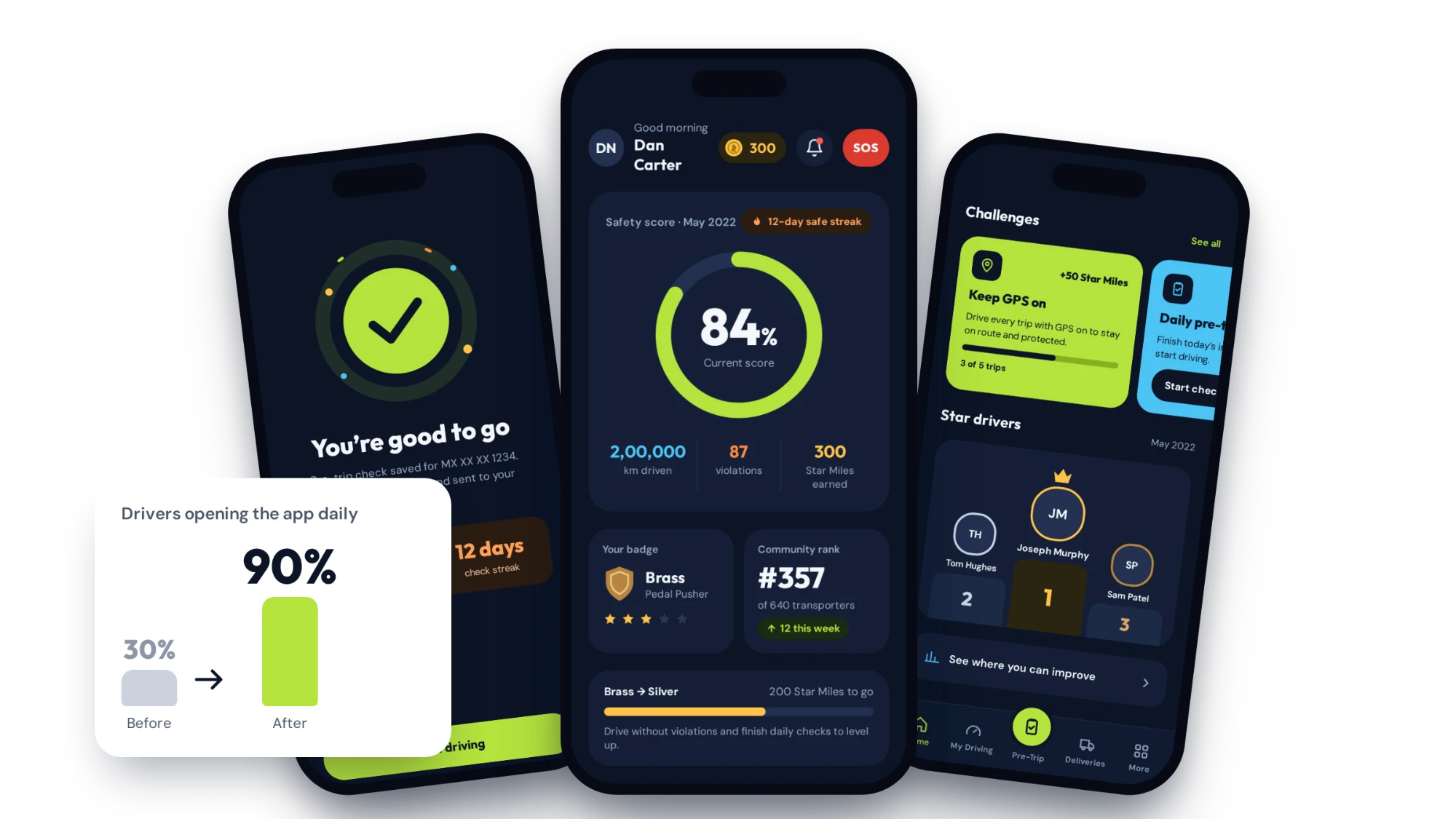
A UK cement manufacturer's app had every feature, but only 30% daily usage. Design took it to 90%.
How I turned a feature-complete app that drivers ignored into one they chose to open — by solving for motivation, not functionality.
30% → 90%Daily app usage after launch
3×Growth in the share of drivers using the app daily
100%Of requested features already shipped, and usage still stuck
MotivationThe real root cause, not functionality
My role
UX Lead
Client
Leading UK cement manufacturer
Timeline
4 months, UX + Engineering
Product
Driver mobile app · Logistics
Overview
The problem, the diagnosis and the outcome in one minute
When adoption is low, the instinct is to build more. This project is a clear example of how I handle it: find out why people aren't using the product before spending more budget on it, then fix the real cause.
The situation
A trucking app had every feature the business had asked for, built exactly to spec. Daily usage was stuck at 30%.
The risk
The obvious next step was a longer feature list: more cost, more complexity, and the same adoption number.
My move
I went to the drivers and listened. The app worked fine. They simply had no reason to open it.
The result
After launch, daily usage rose from 30% to 90%. The business got the adoption it needed.
Challenge
A finished product that nobody wanted to open
Every requested feature had shipped. The app was built exactly to specification. Yet 70% of the people it was built for were not using it on a given day, and nobody could say why.
This is one of the most expensive situations in product work: a delivery success that is an adoption failure. Left alone, it triggers more features, more budget and the same result.
01 — Every requested feature shipped02 — Daily usage stuck at 30%03 — No clear reason why
Insight
I listened to the people avoiding the app
Rather than guess, I connected with truck drivers over Microsoft Teams and let them talk about their frustrations, their routines and the reality of their workday. I expected usability issues. That wasn't the main problem.
"
The problem wasn't functionality. It was motivation. The app worked fine — drivers simply had no reason to open it.
A usability problem asks, "Can people do this?" An adoption problem asks, "Why would they bother?" Naming the right problem is what changed the project.
Approach
A four-step path from an unused app to an engaged driver base
Instead of expanding the feature set, I explored ways to make the tasks drivers already completed every day feel worth doing: points, recognition and rewards tied directly to those actions.
STEP 01
Diagnose
Spoke directly with drivers to separate a usability problem from an adoption problem.
STEP 02
Reframe
Redefined the brief from "add features" to "give drivers a reason to care about the ones we built".
STEP 03
Design
Introduced Star Miles, points earned for completing tasks and redeemable for products on shopping sites.
STEP 04
Energise
Added a leaderboard that turned routine deliveries into friendly competition among drivers.
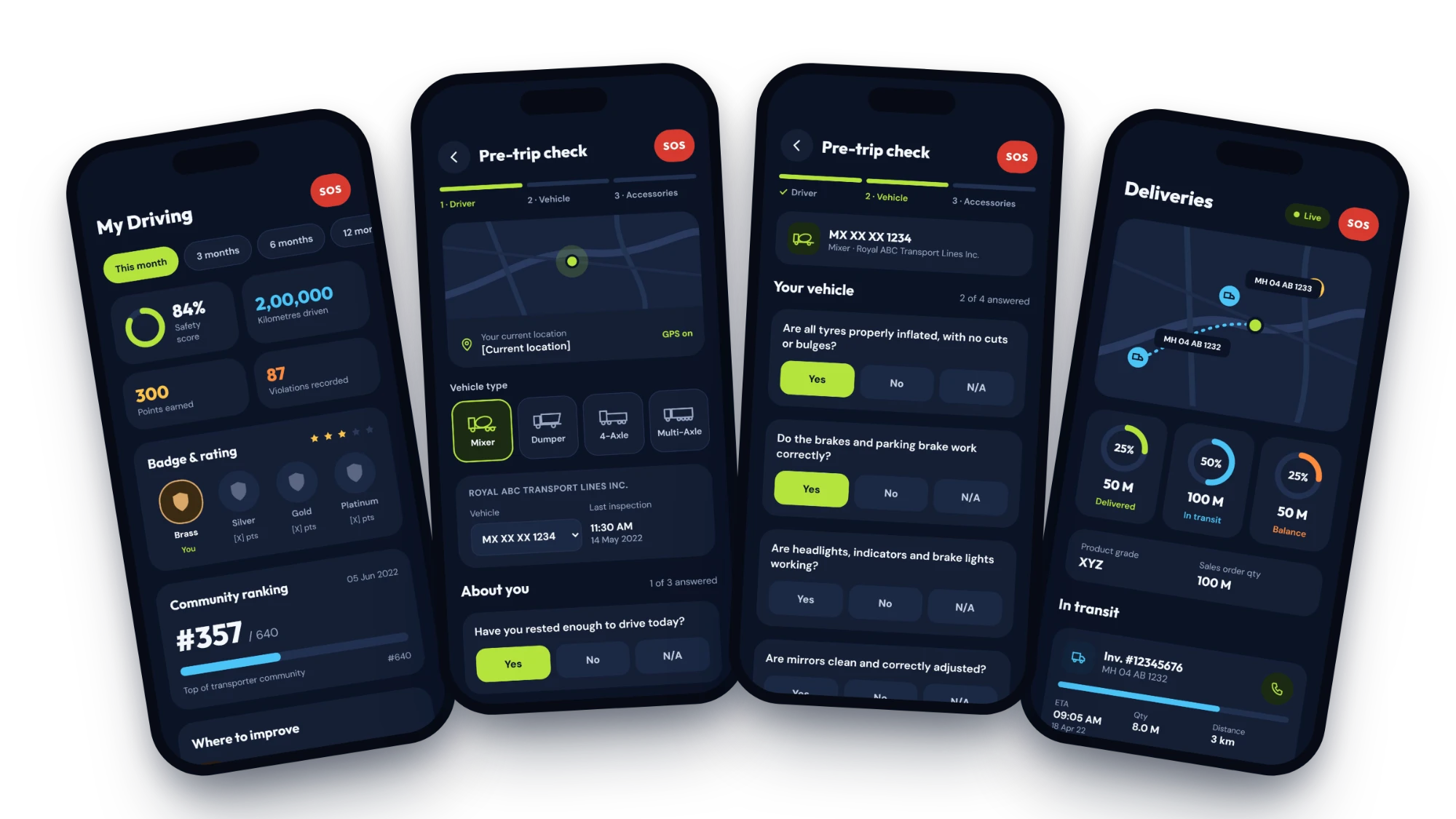
The full driver experience: home dashboard, driving stats, live deliveries, and the pre-trip safety check that feeds the Star Miles system.
Results
Three times the daily usage, from the same set of features
After launch, daily app usage jumped from 30% to 90%. The business got the adoption it had been paying for, and drivers got an experience that motivated them to open the app every day.
30%Daily usage before
90%Daily usage after launch
3×Increase in daily adoption
+60 ptsPercentage-point gain
The lift came from motivation designed around tasks drivers already performed, not from building a longer feature list. Motivation, not more features, closed the gap.
How I work
The problem-solving pattern I bring to your organisation
The trucking app is one example of a habit I apply to every product that isn't delivering. If you lead a team, a product or a budget, this is what you can expect from me.
I diagnose before I prescribe
Low usage can mean many things. I find the actual cause by talking to the people who aren't using the product, then fix that.
I look past the feature list
More features rarely fix a product people have no reason to open. I look for what motivates the behaviour you need.
I design for the person, not just the task
Recognition, reward and a sense of progress change behaviour. I build them into everyday work without adding friction.
I tie design to an adoption number
Success is measured in what people do, such as daily usage, not in how the product looks, so leadership can see the return.
This applies when a product is live but unused, when employees or partners won't adopt a tool you paid for, or when the next feature request looks like an expensive guess. If any of that sounds familiar, write to me at pranjal.productmind@gmail.com.